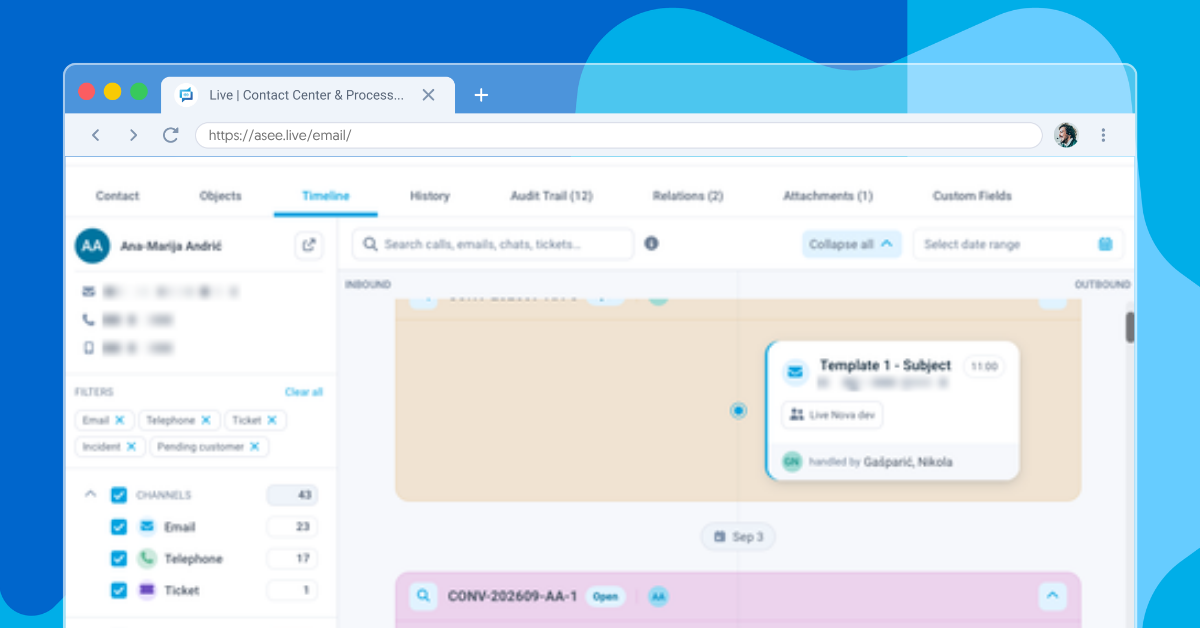
In short: Real-time sentiment analysis uses AI to read a customer's tone and frustration level as the conversation happens, so the agent, including one taking over from a voicebot, knows how the customer feels before they've said a word. On its own, that's useful. Combined with a shared customer record and case history, it means a repeat complaint doesn't start as if it were the first time, and a supervisor can see where frustration is building across the contact center in real time, not just after a case has already escalated.
A customer calls a contact center for the third time this week about the same billing issue. In most setups, the call starts like any other: the agent doesn't yet know this is a repeat contact, let alone how frustrated the customer already is. By the time that becomes clear from tone and word choice, the conversation has often already gone the wrong way.
Complaints get treated as something to resolve and close, which undersells what they actually are: information about where a service, process or journey is falling short, and a rare kind of feedback most dissatisfied customers never bother to give at all.
What happens after the complaint matters just as much as the complaint itself. A 2025 study in the Journal of Brand Management, based on 638 customer responses, found that when a service failure is recovered well, specifically when the outcome and the process both feel fair to the customer, it can increase brand loyalty rather than simply avoid losing the customer. A complaint handled badly does the opposite. The agent handling that conversation is usually the first, and sometimes the only, person with a chance to move it in either direction.
An experienced agent can usually pick up on an irritated customer from tone and word choice. The problem is that agents are rarely doing only that. During a typical call, they're listening, searching for information, checking prior interactions, following procedure and documenting the case, all at once. Emotional cues compete with everything else for attention.
If the agent doesn't already know this is the customer's third call about the same issue, the conversation can start like a routine enquiry, the customer has to explain the problem again, and frustration builds from there. That's rarely a lack of empathy. It's usually that the agent didn't have enough information early enough.
Real-time sentiment analysis uses AI to analyze a customer interaction as it happens and classify it as positive, neutral or negative, often with a frustration signal attached. For a contact center, that's an additional, independent source of information during the conversation, not something the agent has to infer entirely on their own.
This isn't an experimental capability. Gartner predicts that by 2028, 70% of customer service journeys will begin, and be resolved, in a conversational AI interface. As more of the early conversation happens through AI rather than a human, reading sentiment inside that conversation, not just scoring it afterward, stops being optional.
The technology doesn't replace the agent's judgment. It gives the agent another signal to work with, before they need it.
The most useful version of this pairs sentiment analysis with conversational AI. When a voicebot takes the initial part of a call, AI can analyze the conversation in real time, and if it detects a high level of frustration, that information travels with the call when it's handed to a human agent, the same escalation logic our AI Voice Agent uses in a banking contact center applies here too. The agent starts the call already knowing this isn't a routine enquiry.
The same analysis runs on calls that never touch a voicebot at all. A call handled directly by a human agent is still analyzed in real time and classified as positive, negative or neutral, so the agent isn't only relying on their own read of the conversation, whether or not AI handled any part of the call before them.
Knowing a customer is frustrated doesn't explain why. That's why sentiment analysis matters more when it's paired with the customer's history and case context, rather than delivered as an isolated signal.
A contact center's information is often spread across phone calls, emails, chats, SMS and social messages, each with its own record. When that's the case, an agent might know how the customer feels without knowing what happened before, or have the case history without a live read on how the customer is responding right now. It's the same "one customer record" principle behind omnichannel communication: the value comes from one record following the case, not from any single signal on its own.
Put both together and the agent sees who the customer is, what's already happened, and how they're responding in this exact conversation, at the same time.
Sentiment analysis is also useful above the level of a single call. Aggregated across a contact center, it gives supervisors a real-time view of where customer frustration is rising, alongside the metrics they already track: open complaints, wait times, volume and escalations.
If one type of complaint keeps showing up alongside negative sentiment, that's rarely about one agent's performance. It's more often a sign of an unclear process, a recurring product issue or a bottleneck somewhere else in the organization, the kind of pattern that's only visible in aggregate, not in any single call.
| No real-time sentiment signal | With real-time sentiment analysis | |
|---|---|---|
| Agent's first cue | Tone and word choice, noticed partway into the call | A sentiment and frustration signal, available before the agent speaks |
| Repeat contact | Often starts like a first-time enquiry | Flagged as a repeat contact if paired with case history |
| Voicebot handoff | Human agent starts cold after a transfer | Frustration signal travels with the call to the human agent |
| Escalation timing | Recognized once the conversation has already gone wrong | Recognized as it's forming, while there's still room to adjust |
| Supervisor visibility | Frustration only visible complaint by complaint | Aggregated view of where frustration is rising contact center-wide |
When channels, case history and the customer record already sit in one system, a sentiment signal is a layer on top of that, not a separate tool to check. Whether a call starts with a voicebot or goes straight to a human agent, the same analysis runs, and the result, positive, negative or neutral, plus any frustration flag, becomes part of what the agent already sees, rather than a second screen to watch.
For supervisors, that same signal feeds into the real-time dashboards and wallboards already used for service level, volume and quality, so frustration trends show up alongside the metrics a team already watches, not in a separate tool nobody checks.
For agents, earlier awareness makes it easier to adjust their approach before a conversation escalates. For supervisors, an aggregated sentiment view is another signal for where attention is needed right now, not just after a complaint has already been logged. For the organization, recurring sentiment patterns can surface issues that would otherwise only show up through individual complaints, or through customers who leave without complaining at all. For the customer, the experience is simpler: nothing has to be repeated, and the agent already has a sense of what's going on before the conversation starts.
Most of this is easier to see than to describe in the abstract, so book a demo to see sentiment and case history reach the same agent screen, on a real call.
It's an AI capability that analyzes a customer interaction as it happens and classifies it as positive, neutral or negative, often with a frustration signal, so the agent has an independent read on how the customer feels instead of relying only on their own interpretation of tone and word choice.
When a voicebot handles the first part of a call, AI analyzes sentiment as the conversation happens. If frustration is detected, that signal travels with the call when it's handed to a human agent, so the agent starts already knowing this isn't a routine enquiry.
No. The same analysis runs on calls a human agent handles directly from the start, classifying the conversation as positive, negative or neutral in real time, independently of whether AI was involved earlier in the interaction.
No. It gives agents an additional, earlier signal to work with. The agent still decides how to respond, investigates the case and takes action; the technology doesn't automate empathy, it helps agents recognize sooner when it's needed.
Yes. Aggregated sentiment data feeds into the same real-time dashboards supervisors already use for service level, volume and quality, so rising frustration is visible as a pattern across the contact center, not only complaint by complaint.