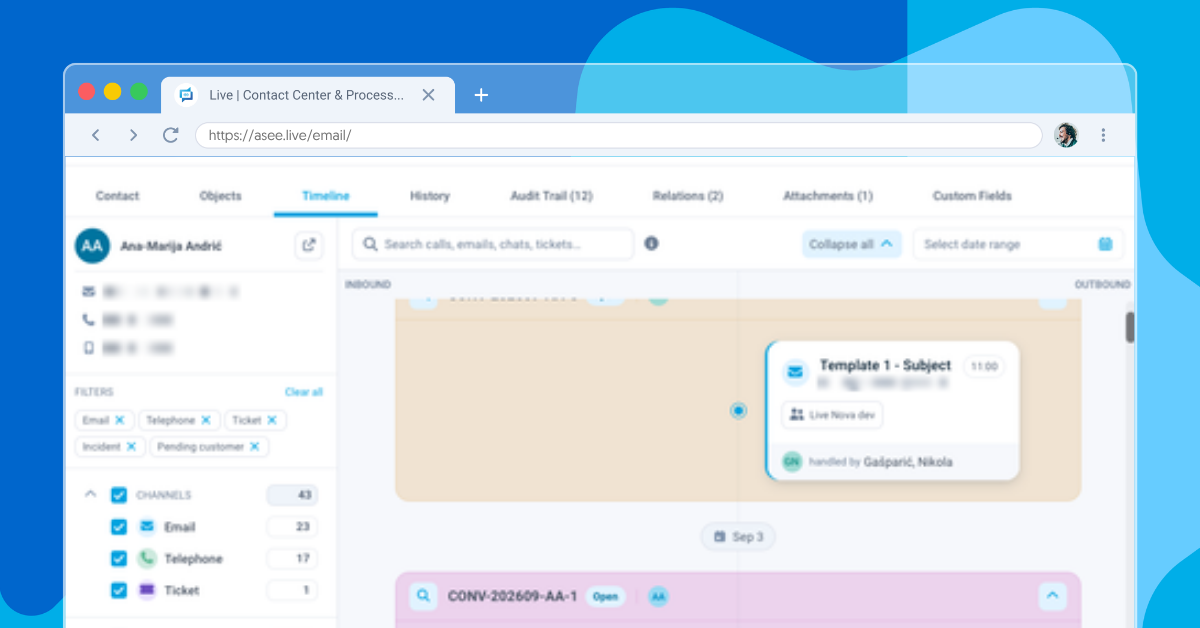
In short: IT service management (ITSM) and customer service are usually run on separate systems, one for internal IT tickets, one for customer-facing requests, even though both are really the same thing: a request, a priority, an owner and a deadline. When they share one platform and one data model instead, a customer-facing complaint and the internal IT incident behind it become the same record, visible to both teams in real time, instead of two disconnected tickets that someone has to reconcile by hand.
A mobile app goes down on a Tuesday morning. Within minutes, the contact center is taking calls and chat messages from customers who can't log in. At the same time, IT is already working the outage as an internal incident: diagnosing the cause, paging the right team, tracking time to resolution.
In most organizations, those two things happen in two different systems that don't talk to each other. The contact center logs each customer complaint as its own ticket, in a tool built for customer interactions. IT works the outage in a separate ITSM platform, built for infrastructure and change management. Nobody on either side has a single view of both: how many customers are actually affected, what to tell them about timing, or when the volume of complaints should escalate the incident's priority instead of the other way around.
This isn't a niche IT problem. According to HDI's State of Service Management in 2024 report, a survey of IT service management practitioners, 52% of organizations report that service management practices now extend beyond IT into non-IT business units, particularly customer service, HR and business operations (HDI, 2024). The same report found that 59% identify improving customer experience as the main driver behind their ITSM projects, ahead of any purely technical justification.
In other words, the practitioners closest to this work are already saying that IT service management and customer service are converging. Most organizations' tooling hasn't caught up: the systems are still separate, even when the priorities aren't.
A customer complaint and an IT incident are, underneath the labels, the same kind of record: something was requested or something broke, it's assigned to someone, it has a priority and a deadline, and someone needs to be able to show what happened afterward. Treating them as two unrelated categories of software is a historical accident, not a technical necessity.
On a platform built around one data model, that shows up as a small number of shared components rather than two parallel toolsets:
This is the same underlying idea behind omnichannel communication: one record that follows the request, instead of a new one every time it crosses a boundary. Here, the boundary is between customer-facing and internal, not between channels.